
Books



Books by Rabbi Gil Student
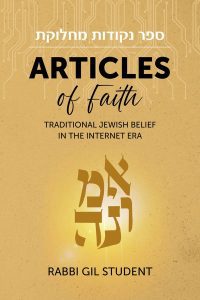
 Articles of Faith: Traditional Jewish Belief in the Internet Era
Kodesh Press, 2024
As the internet developed and evolved, Rabbi Gil Student stood out as a pioneer in using the technology to create a community dedicated to meaningful study of Torah. His blog Hirhurim, now the online periodical Torah Musings, explores timely issues of faith and meaning in the contemporary world based on classical Jewish texts. Articles of Faith marks the twentieth anniversary of Hirhurim-Torah Musings with a history of the website and in-depth analyses of controversial topics of Jewish belief, bringing traditional Jewish texts and commentaries to bear on the most contentious religious issues of the day.
“Rabbi Gil Student is one of the most engaging of contemporary rabbinic scholars, bringing the vast resources of halakhah and Jewish ethics to bear on a formidable range of contemporary issues” – Rabbi Lord Jonathan Sacks zt”l, Chief Rabbi Emeritus of the United Hebrew Congregations of the Commonwealth
“Rabbi Gil Student’s Articles of Faith masterfully navigates the intricate landscapes of contemporary issues through the lens of ancient Torah texts in an intelligent, eloquent, and insightful manner” – Rabbi Menachem Genack, CEO of OU Kosher
“The book is a Kiddush Hashem and a good-spirited celebration of the Torah’s vitality and eternity” – Rabbi Haim Jachter
“This is a book not to be missed.” – Rabbi Leonard Matanky
“Agree or disagree with Rabbi Student’s conclusions, any thoughtful individual should read this formidable book and mine its wealth of sources and analysis.” – Rabbi Hayyim Angel
“I highly recommend this book. If you want to know what the fundamentals of Judaism have to say about the online world in which we live today, Articles of Faith is a great way to begin that journey.” – Rabbi Harry Maryles
Interviews & Events
- Book launch press release
- Book launch video
- Seforim Chatter
- Zev Brenner Show
- New Books Network with Michael Morales
- Judaism Demystified with Ben and Benzi
- Shtark Tank with Yaakov Wolff
- Rootless with Liel Leibovitz
- Philosophical Jew with Dovidchai Abramchayev
- Jewish Vues
Reviews
- R. Haim Jachter at The Jewish Link
- R. Hayyim Angel at Jewish Ideas
- R. Reuven Chaim Klein at Jerusalem Report
- R. Leonard Matanky at The Jewish Press
- R. Gidon Rothstein at Tradition Online
- R. Harry Maryles at Emes Ve-Emunah
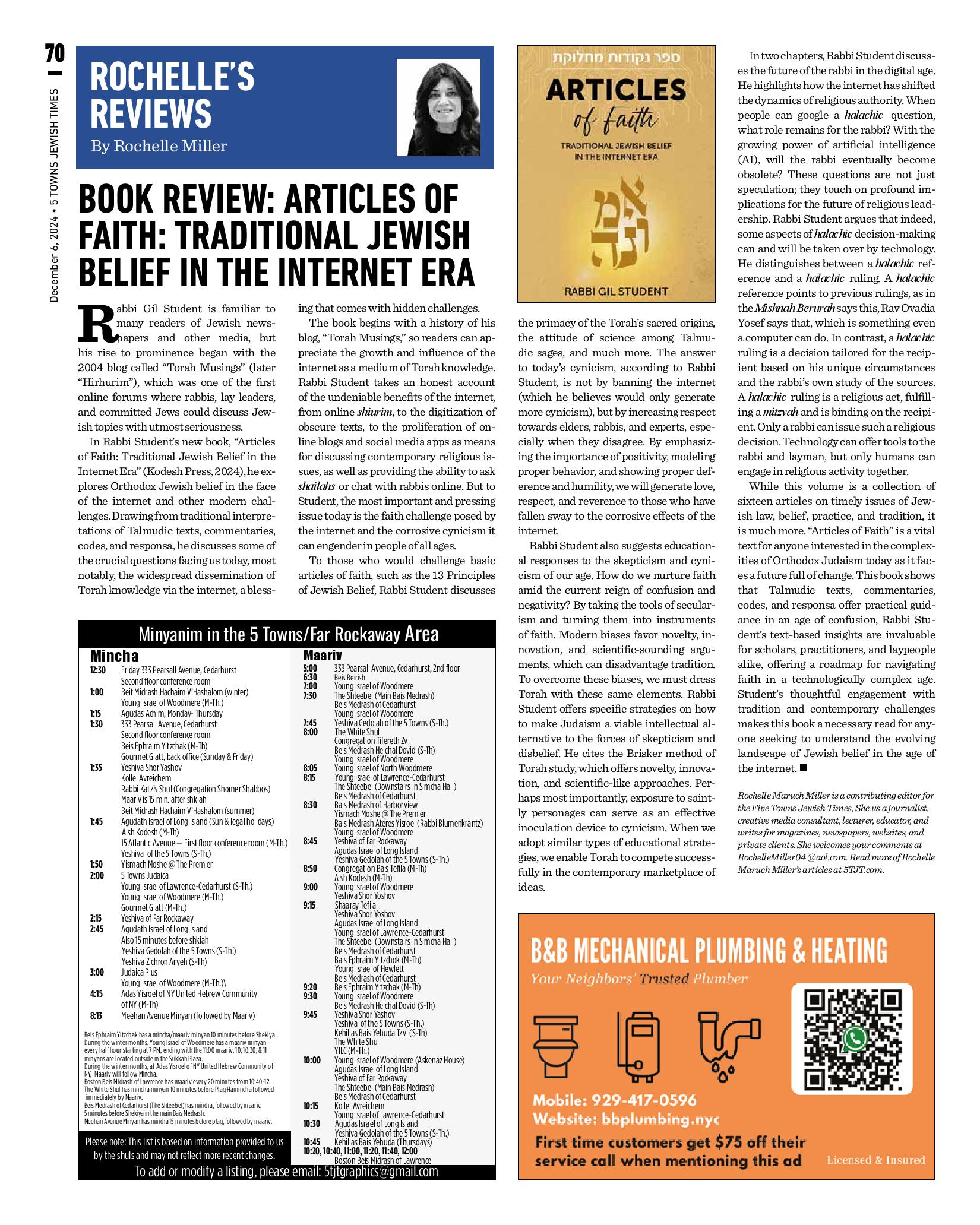
- Rochelle Miller at Five Towns Jewish Times
- Yonatan Burns at YU Commentator
- Ben Rothke at The Jewish Link
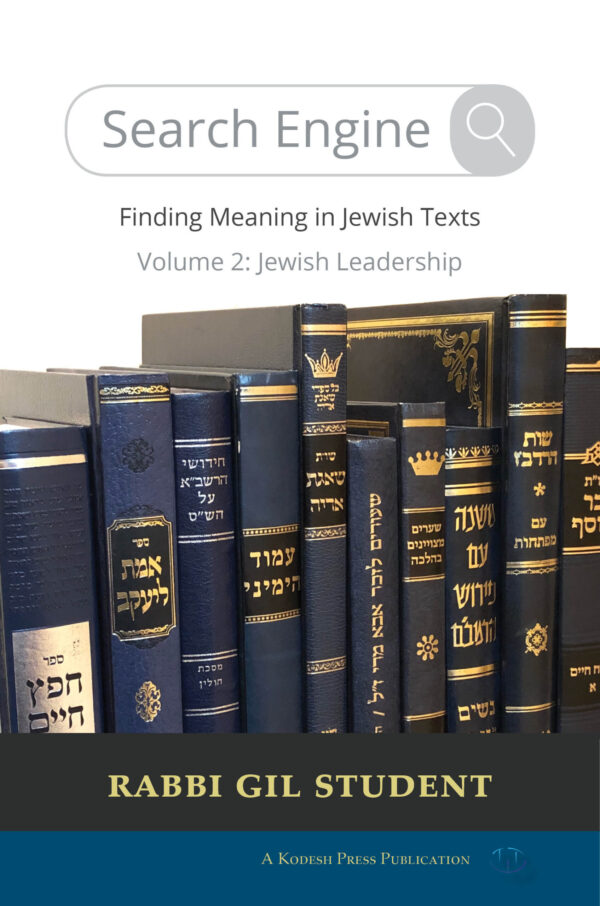
 Search Engine: Finding Meaning in Jewish Texts
Volume 2: Jewish Leadership
Kodesh Press, 2018
Rabbi Gil Student tackles the most important issues about Jewish leadership, community, and autonomy in his second volume of Search Engine. What exactly is a rabbi – a legal authority, a community organizer, an inspirational speaker, or some combination? What exactly is ordination and can it ever be revoked? Are there any limitations on who can be called a “rabbi”?
In addition, he asks questions to the laity: what does it mean to be a member of the community for a lay-person? Are there obligations incumbent on individuals concerning how they view the rabbinate and Jewish leadership in general? Under what circumstances is it proper for a community to divide, and how does that relate to the value of Jewish unity? Are there beliefs or actions, on the left or right, that are beyond the boundaries of Orthodoxy?
 Search Engine: Finding Meaning in Jewish Texts
Volume 1: Jewish Life
Kodesh Press, 2018
An innovative thinker who applies classical Jewish texts to contemporary life questions, and a pioneer of the Jewish internet, Rabbi Gil Student has been exploring the big and small Jewish questions to wide acclaim. In Search Engine, he examines Jewish life in this era of social media and mobile technology through the lens of Jewish law, surveying topics in accessible and engaging ways, and offering depth and breadth to the novice and the expert. With the back-and-forth of proof and counterproof, early and late commentaries are brought to bear on both the what and why of contemporary issues. Rabbi Gil Student is the Publisher and Editor-in-Chief of TorahMusings.com. He writes frequently in Jewish newspapers and magazines, serving as a regular contributor to Jewish Action, The Jewish Link of New Jersey, The Jewish Echo, and The Vues. Rabbi Student serves on the Executive Committee of the Rabbinical Council of America, on the Editorial Board of the Orthodox Union’s Jewish Action magazine, and as the magazine’s Book Editor.
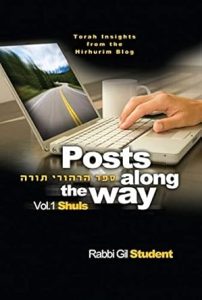
 Posts Along the Way
Volume 1: Shuls
Yashar Books, 2009
Posts Along The Way is an adaptation of the Torah teachings on the popular Hirhurim-Musings blog. In this book, learn about the halachah and hashkafah of shuls in the quick and enlightening blog format. Take a guided tour of the sources and see how they are relevant to the Judaism you live and experience. Topics include how prayer works, talking in shuls, who can be a rabbi – a ba'al teshuvah? a convert? a woman?, shuls and megachurches, women's prayer groups, mechitzah and much more. Hirhurim-Musings is an award-winning blog that has been mentioned in The Wall Street Journal, The Jewish Press and other media outlets.

 Can The Rebbe Be Moshiach?
Proofs from Gemara, Midrash, and Rambam that the Rebbe zt”l cannot be Moshiach
Universal Publishers, 2002
During his lifetime, the Lubavitcher Rebbe, Rabbi Menachem Mendel Schneerson of blessed memory, was a highly successful religious leader. His brilliant scholarship and eloquent speaking touched hundreds of thousands of people. Larger than life and presiding in a post-Holocaust world during which Jews returned to the land of Israel in an unprecedented fashion, he was declared by many of his followers to be the Moshiach (Messiah) for whom Jews have waited for thousands of years. His death in 1994 should have dashed those hopes. However, many of his followers have advanced the position that even today the Rebbe can still be Moshiach. This book is an analysis of this position within the Jewish tradition. What do the doctrinally binding texts say about a dead man being Moshiach? In a presentation appropriate for both the layman and the experienced scholar, this work demonstrates from dozens of texts that according to the authentic Jewish tradition the Rebbe unfortunately cannot be Moshiach.
Books Straight From Torah Musings
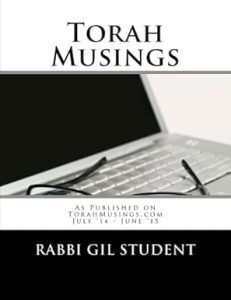
 Torah Musings
As published on TorahMusings.com July 2015 to June 2016
CreateSpace, 2016
Torah Musings is a window into the Orthodox Jewish intellectual world, providing sophisticated but popular textual studies, important news stories and associated commentary from the perspective of an Orthodox Judaism that is intellectually open and halakhically conservative.
Torah Musings
As published on TorahMusings.com July 2014 to June 2015
CreateSpace, 2015
Torah Musings is a window into the Orthodox Jewish intellectual world, providing sophisticated but popular textual studies, important news stories and associated commentary from the perspective of an Orthodox Judaism that is intellectually open and halakhically conservative.
Books Co-Edited by Rabbi Gil Student
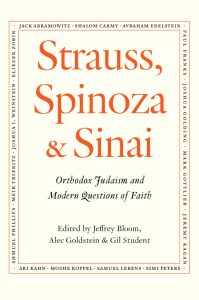
 Strauss, Spinoza & Sinai
Orthodox Judaism and Modern Questions of Faith
Edited by Jeffrey Bloom, Alec Goldstein & Gil Student
Kodesh Press, 2022
More than three centuries after Baruch Spinoza’s excommunication from the Jewish community of Amsterdam, his legacy remains contentious. Born in 1632, Spinoza is one of the most important thinkers of the Enlightenment and arguably the paradigm of the secular Jew, having having left Orthodoxy, i.e. traditional Jewish beliefs, without converting to another faith. One of the most unexpected and provocative critiques of Spinoza comes from Leo Strauss. Strauss grew up in a nominally Orthodox home and emigrated from Germany to the United States in the 1930s. He taught at the University of Chicago and was one of the most influential political philosophers of the twentieth century until his death in 1973. Though Strauss was not an Orthodox Jew, in a well-known essay that prefaced his study of Spinoza, he critically examines modern philosophy’s challenge to traditional religion. There he argues that while the Enlightenment had failed to decisively refute Orthodoxy, at the same time, Orthodoxy could only claim to believe its core tenets were true but could not claim to know they were true. Strauss leaves the question at an impasse; both the Enlightenment and Orthodoxy rest on axioms that neither side can fully prove or fully refute. Curiously, Strauss never asks Orthodox Jewish thinkers if his approach to defending Judaism against the claims of the Enlightenment is the same as theirs. This volume poses the question to a group of serious Orthodox Jewish thinkers in an attempt to find out if Orthodoxy has a better answer to the questions raised by Strauss than the one Strauss advanced on its behalf. The seventeen essays in this volume use a variety of approaches, drawing on traditional primary Jewish sources like Scripture, Talmud, and Midrash; medieval rationalists like Maimonides; Enlightenment-era Orthodox sources; Jewish mystical writings like Kabbalah and Chasidut; modern philosophical movements including postmodernism and analytic philosophy; and contemporary Jewish Bible interpretation. While the answers differ, what unites these essays is the willingness to take Strauss’ question seriously and to provide “inside” answers, that is, answers given by Orthodox Jews.
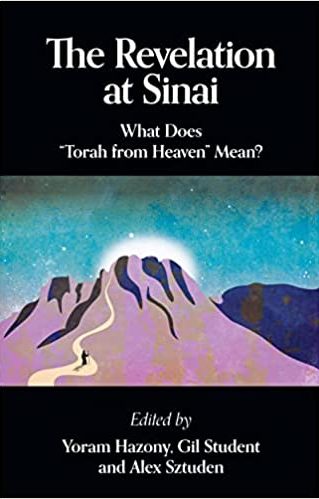
 The Revelation at Sinai
What Does “Torah from Heaven” Mean?
Edited by Yorah Hazony, Alex Sztuden & Gil Student
Ktav, 2021
The Bible contains commands and narratives that are the foundations of Jewish tradition and Western Civilization. Both the narratives and the law constitute what Jewish tradition calls Torah from heaven, God’s communication to mankind, which reaches its greatest form in God’s revelation of the Torah to Moses at Sinai. What is so important about God’s revelation to Moses at Sinai? How are we to understand what happened there and why does Judaism consider this event essential? This volume takes a fresh look at the idea of Torah from heaven. It includes eleven new essays within the tradition of Orthodox Judaism, which together examine the historical, theological, and philosophical aspects of the giving of the Torah at Sinai.
 Morasha Kehillat Yaakov
Essays in Honour of Chief Rabbi Lord Jonathan Sacks
Edited by Michael Pollak, Shmuel Simons, Gil Student
Maggid Press, 2014
Rabbi Jonathan Sacks is one of the most distinguished rabbinic leaders of our day and a world renowned spokesman for Judaism. To honor him upon his retirement from the chief rabbinate of the United Hebrew Congregations of Great Britain and the Commonwealth, his colleagues from the London Beth Din and the United Synagogue have produced a volume of stellar rabbinic scholarship. In this volume, eminent rabbis such as Rabbi Aharon Lichtenstein and Rabbi Adin Steinsaltz join together with many others in tribute to a scholar and a leader.
 The Koren Mesorat HaRav Siddur
A Hebrew/English Prayer Book with Commentary by Rabbi Joseph B. Soloveitchik
Edited by Arnold Lustiger, Gil Student & Simon Posner
OU Press and Koren, 2011
The Koren Mesorat HaRav Siddur is the first complete, Orthodox prayer book with commentary by the seminal scholar and leader, The Rav, Rabbi Joseph B. Soloveitchik. The Siddur presents Rabbi Soloveitchiks exceptional insights on prayer, which have been adapted from his writings, public lectures, and classes. It is complemented by an elegant presentation in the renowned tradition of Koren Publishers Jerusalem, and an eloquent English translation and introduction by the esteemed Rabbi Sir Jonathan Sacks. Published in cooperation with the Orthodox Union.